Xiamen Zopin New Material Limited Established in 2011, it is a new material industry with capabilities of independent research & development, production and sales as one. Our ISO9001:2012 factory covers an area of 6 hectares and a building area of 28,000 square meters, with annual production of high-performance metal foams of 250,000 square meters. Our R&D team is composed of academicians and experts from Tsinghua University, Polytechnic University of Hong Kong, Nanyang Technological University, and other domestic and foreign metal foam professionals. After many years’ endeavor, we now own our proprietary intellectual property rights in manufacturing high purity and high porosity metal foams.
Carbon Foam Electrodes: A Revolutionary Material for Energy Storage and Conversion
Carbon foam electrodes are a cuttingedge development in the field of electrochemistry, leveraging the unique properties of carbon foam to enhance performance in batteries, supercapacitors, fuel cells, and other energy storage and conversion systems. Below is an indepth exploration of carbon foam electrodes, their characteristics, applications, and advantages.
●1. What Are Carbon Foam Electrodes?
Carbon foam electrodes are porous, lightweight materials composed of interconnected carbon structures. These electrodes combine the benefits of high surface area, excellent electrical conductivity, mechanical stability, and thermal management, making them ideal for various electrochemical applications.
Key features of carbon foam electrodes include:
High Surface Area: Provides numerous active sites for electrochemical reactions.
Porous Structure: Facilitates ion transport and enhances reaction kinetics.
Excellent Conductivity: Enables efficient electron transfer.
Lightweight Design: Reduces overall system weight.
●2. Why Use Carbon Foam as an Electrode Material?
Carbon foam offers several advantages over traditional electrode materials like graphite or metal foams:
| Advantage | Description |
|||
| High Surface Area | Increases the number of active sites for electrochemical reactions. |
| Excellent Conductivity | Ensures fast electron transfer and higher power output. |
| Mechanical Stability | Resists deformation during cycling, improving durability. |
| Thermal Management | Dissipates heat effectively, preventing overheating and enhancing safety. |
| Lightweight Structure | Reduces the overall weight of energy storage systems. |
| Sustainability | Can be derived from renewable or recycled materials. |
●3. Manufacturing Processes for Carbon Foam Electrodes
Carbon foam electrodes can be produced using various techniques, each with its own advantages and limitations:
A. Chemical Vapor Deposition (CVD)
Process: Carbon atoms are deposited onto a substrate under high temperature and pressure.
Advantages: Precise control over pore size and morphology.
Limitations: High cost and complexity.
B. Pyrolysis
Process: Organic precursors (e.g., polymers, biomass) are thermally decomposed in an inert atmosphere to form carbon foam.
Advantages: Scalable and costeffective.
Limitations: Requires optimization of precursor selection and processing conditions.
C. Replication Methods
Process: A sacrificial template (e.g., polymer foam) is infiltrated with carbon precursors, by carbonization.
Advantages: Simple and versatile.
Limitations: May result in less uniform structures.
D. 3D Printing/Additive Manufacturing
Process: Carbon foam is fabricated layer by layer using advanced printing techniques.
Advantages: Customizable geometries and high precision.
Limitations: Expensive and still developing technology.
●4. Applications of Carbon Foam Electrodes
A. LithiumIon Batteries
Role: Carbon foam serves as the anode material, replacing traditional graphite.
Advantages:
Higher energy density due to increased surface area.
Faster charging rates due to improved ion transport.
Applications: Electric vehicles, consumer electronics.
B. Supercapacitors
Role: Carbon foam acts as the electrode material, providing high surface area for rapid charge storage and discharge.
Advantages:
High power density for fast energy delivery.
Long cycle life due to nonfaradaic charge storage mechanisms.
Applications: Backup power systems, regenerative braking in electric vehicles.
C. SodiumIon Batteries
Role: Carbon foam electrodes enhance the performance of sodiumion batteries, which offer a more sustainable alternative to lithiumion technologies.
Advantages:
Abundant sodium resources reduce costs.
Improved cycle life and energy efficiency.
Applications: Gridscale energy storage, lowcost portable devices.
D. Fuel Cells
Role: Carbon foam supports catalyst layers in fuel cells, improving reaction rates and durability.
Advantages:
Enhanced proton exchange membrane (PEM) fuel cell performance.
Lightweight and durable structure.
Applications: Automotive fuel cells, stationary power generation.
E. Water Splitting and Electrolyzers
Role: Carbon foam electrodes act as catalyst supports for hydrogen production via water splitting.
Advantages:
High surface area for enhanced catalytic activity.
Corrosion resistance in harsh electrolyte environments.
Applications: Renewable hydrogen production, green energy systems.
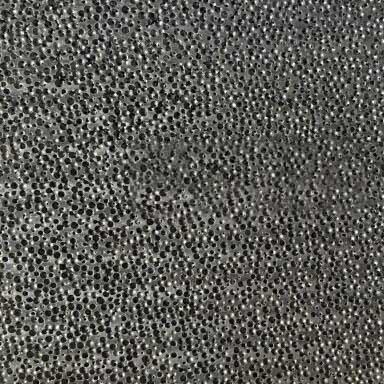
Spherical Open-Cell Aluminum Foam
●5. Key Characteristics of Carbon Foam Electrodes
| Characteristic | Description |
|||
| Surface Area | Typically ranges from 500 to 2000 m²/g, depending on the manufacturing process. |
| Porosity | Opencell structure with porosity up to 95%, enabling efficient ion transport. |
| Conductivity | Electrical conductivity ranges from 100 to 1000 S/cm, ensuring fast electron transfer. |
| Mechanical Strength | High compressive strength and flexibility, resisting deformation during cycling. |
| Thermal Stability | Operates effectively at temperatures up to 1000°C, depending on the formulation. |
●6. Challenges and Limitations
A. Cost
Advanced manufacturing techniques like CVD or 3D printing can increase production costs.
Solution: Develop scalable and costeffective processes, such as pyrolysis or recycling.
B. Cycle Life
Repeated charging/discharging may degrade the carbon foam structure over time.
Solution: Optimize material composition and design to enhance durability.
C. Compatibility
Integrating carbon foam electrodes into existing battery architectures may require significant modifications.
Solution: Collaborate with manufacturers to standardize designs.
D. Catalyst Support
In fuel cells and water splitting applications, carbon foam may experience corrosion or degradation in certain electrolytes.
Solution: Apply protective coatings or use corrosionresistant formulations.
●7. Future Trends and Innovations
A. Hybrid Materials
Combining carbon foam with other advanced materials (e.g., graphene, silicon, metal oxides) to further enhance performance.
B. Sustainable Production
Developing ecofriendly methods to produce carbon foam from renewable or wastederived precursors.
C. SolidState Systems
Incorporating carbon foam electrodes into solidstate batteries and fuel cells to improve ion conductivity and safety.
D. Artificial Intelligence and Machine Learning
Using AIdriven modeling to optimize carbon foam electrode design and performance.
●8. Suppliers and Research Institutions
If you're exploring carbon foam electrodes, here are some key players:
Graphene Solutions: Specializes in hybrid carbon materials for energy storage.
Porvair Advanced Materials: Provides carbon foam solutions for battery and fuel cell applications.
Universities and Research Labs: Institutions like MIT, Stanford, and Tsinghua University are actively researching carbon foam electrode technologies.
●9. Conclusion
Carbon foam electrodes represent a transformative advancement in electrochemical systems, offering unparalleled performance, sustainability, and versatility. Their unique combination of high surface area, excellent conductivity, and mechanical stability positions them as key players in nextgeneration energy storage and conversion technologies.
Whether for lithiumion batteries, supercapacitors, fuel cells, or water splitting systems, carbon foam electrodes have the potential to revolutionize the way we generate, store, and utilize energy. If you're considering carbon foam electrodes for your project, carefully evaluate factors such as application requirements, budget, and desired performance metrics. For further details or assistance, feel free to ask!


 Daisy@foam-material.com