Procurement teams face constant delays and inflated quotes when sourcing porous substrates for pilot runs or scale-up assembly. Finding a direct manufacturer that balances laboratory flexibility with bulk factory capacity remains difficult. This guide outlines how to evaluate open-cell structural specs, verify supplier lead times, and buy copper foam directly from certified production lines without excessive minimum order barriers.
Evaluating porous conductive substrates requires strict attention to pore uniformity and structural density. Engineers often balance surface area against fluid permeability. Standard industrial options provide open-cell structures with porosity between 95% and 98%, ensuring superior fluid flow and high surface contact. You can inspect continuous pores across pore densities ranging from 10 to 150 PPI.
Thermal conductivity exceeds 6W/M.K, making the material effective for compact heat sink fins and chemical catalyst carriers. When teams order porous copper sheet materials, thickness uniformity prevents hot spots during electrode coating. Purity levels exceed 99%, delivering low contact resistance across high-rate cycling tests. Tensile strength spans 5 to 18MPa, ensuring reliable handling during automated winding or stacking operations.
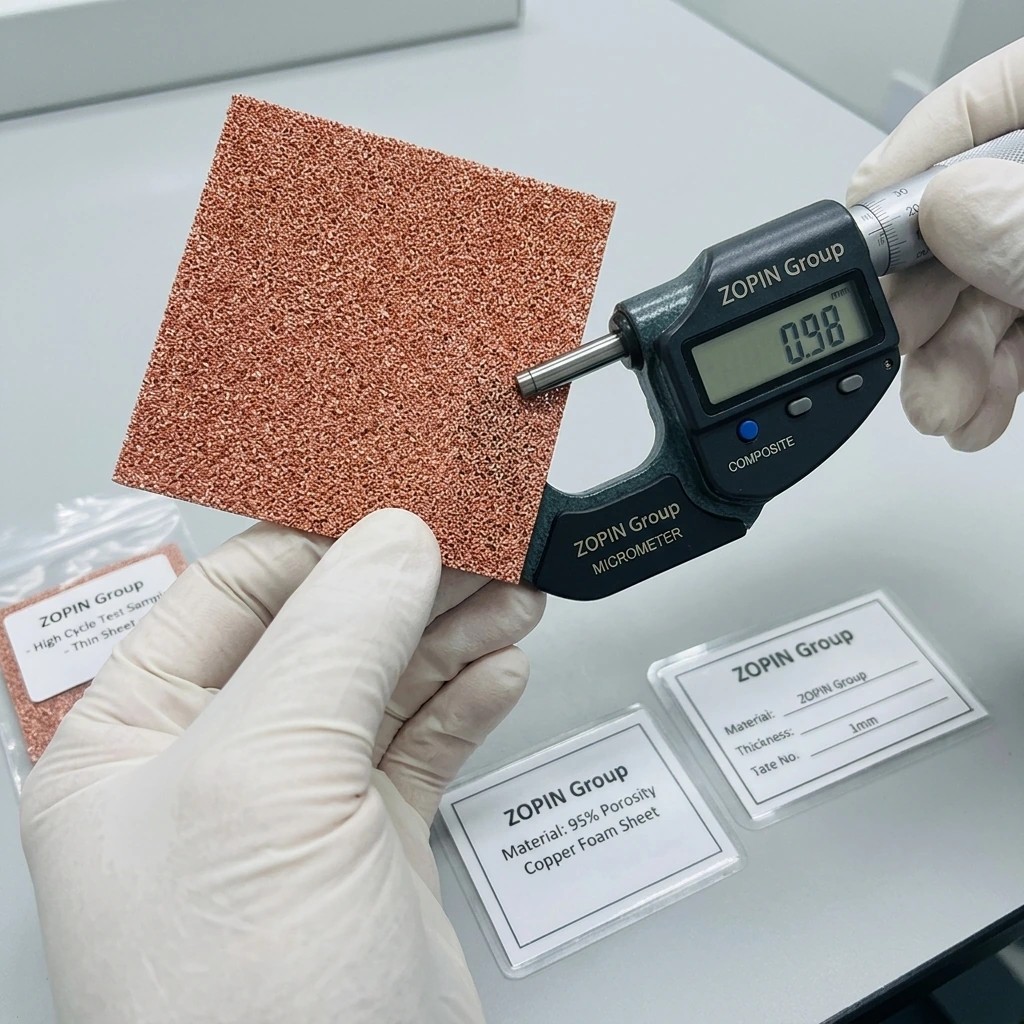
Standard sheet sizes like 500x500mm and 200x300mm serve most standard evaluation fixtures. You can learn more about dimensional limits through our specialized catalogue.
Research divisions frequently struggle with large factory minimums during material validation phases. Sourcing single sheets shouldn't require lengthy contract discussions or distributor markups. Working with an in stock cu foam supplier allows researchers to test prototypes without committing production budgets to excess warehouse inventory.
Flexible manufacturing facilities accommodate thickness bands from ultra-thin 80 micrometers up to 20 millimeters. While laboratories require small moq copper foam for baseline trials, pilot production requires uninterrupted bulk feeds. A modern 28000 square meter manufacturing floor provides an annual output of 250000 square meters. That level of infrastructure supports rapid shifts from prototype cutting to continuous multi-meter deliveries. For specialized formats, exploring options helps match odd die geometries or composite requirements.
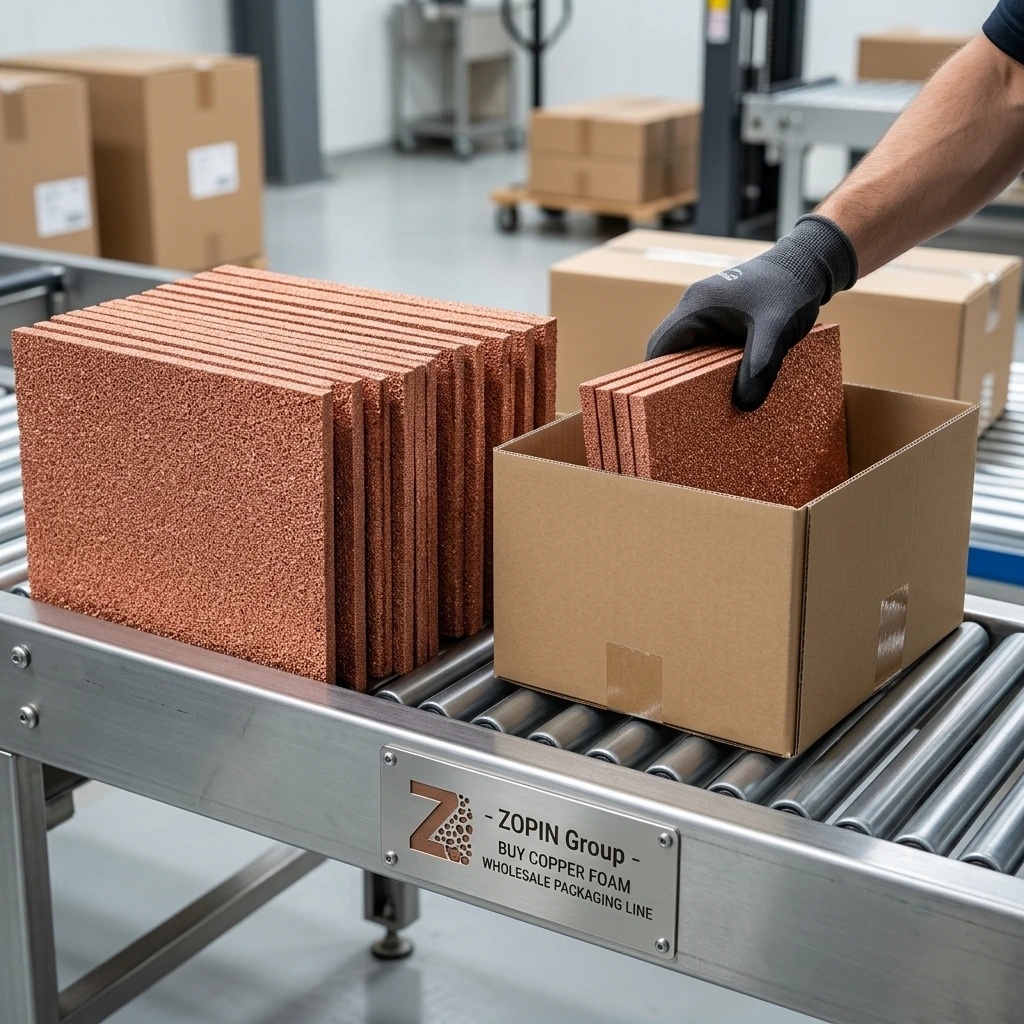
Procurement timelines often collapse when international shipments lack robust logistics planning. Standard orders move through processing in 12 to 24 hours, while specialized factory runs conclude in two weeks. Materials require seaworthy timber crating or reinforced carton layers to eliminate strut deformation during air transit.
High-capacity battery development demands consistent mass loading across each lot. Production engineers who buy wholesale battery copper foam rely on certified ISO 9001 quality systems and SGS facility audits. Batch traceability guarantees repeatable pore metrics from trial cells to operational packs. For broader component sourcing across collector tabs or bipolar plates, checking compatible ensures chemical compatibility across the cell stack.
Sample orders start at a minimum quantity of 1 piece directly from our stock inventory. You can request tailored cut sizes, pore densities from 10 to 150 PPI, and thicknesses starting from 80 micrometers. Standard test panels ship immediately via express air freight.
All lots undergo strict pore distribution checks, tensile testing, and chemical purity assays under certified ISO 9001 protocols. Stable tensile ratings between 5 and 18MPa prevent web snapping during continuous slot-die slurry coating and roll-to-roll calendering.
Standard catalog sizes process within 12 to 24 hours from initial order confirmation. Shipments travel in export-grade protective crating via DHL, FedEx, or standard air freight, supported by a 12-month quality guarantee.

Copyright © Xiamen Zopin New Material Limited. All Rights Reserved.
the professional team to service !

 Daisy@foam-material.com