Xiamen Zopin New Material Limited Established in 2011, it is a new material industry with capabilities of independent research & development, production and sales as one. Our ISO9001:2012 factory covers an area of 6 hectares and a building area of 28,000 square meters, with annual production of high-performance metal foams of 250,000 square meters. Our R&D team is composed of academicians and experts from Tsinghua University, Polytechnic University of Hong Kong, Nanyang Technological University, and other domestic and foreign metal foam professionals. After many years’ endeavor, we now own our proprietary intellectual property rights in manufacturing high purity and high porosity metal foams.
Stainless Steel Mesh: Overview, Features, Manufacturing, Applications, Advantages, and Conclusion
Stainless steel mesh is a versatile metal material widely used in industrial, architectural, and scientific applications due to its excellent strength, durability, and corrosion resistance. It consists of interwoven stainless steel wires, forming a grid or fabric-like structure that combines mechanical robustness with permeability. Stainless steel mesh serves as a critical material in filtration, separation, reinforcement, and protective applications, offering high performance in both harsh and everyday environments.
Overview
Stainless steel mesh is manufactured from austenitic, ferritic, or duplex stainless steel grades, such as 304, 316, and 310. The choice of alloy determines the mesh’s corrosion resistance, tensile strength, and temperature tolerance. This material is commonly produced in various weave patterns, such as plain weave, twill weave, and Dutch weave, allowing precise control over pore size, wire diameter, and mesh density. These characteristics make stainless steel mesh suitable for a wide range of industrial, architectural, and scientific applications.
Key Features of Stainless Steel Mesh
Several key features distinguish stainless steel mesh as a premium metal material:
Corrosion Resistance: Resistant to rust, oxidation, and chemical corrosion, making it suitable for both indoor and outdoor environments.
High Strength and Durability: Excellent tensile strength and fatigue resistance enable use in mechanical and structural applications.
Temperature Tolerance: Maintains integrity under high or fluctuating temperatures, suitable for industrial processes.
Versatile Permeability: Adjustable pore size and mesh count allow controlled filtration, separation, and ventilation.
Wear and Abrasion Resistance: Long service life even under high mechanical stress.
Hygienic and Easy to Clean: Smooth surface and non-porous properties make it ideal for food, pharmaceutical, and medical applications.
Manufacturing Process
The production of stainless steel mesh involves several key steps:
Wire Drawing: Stainless steel rods are drawn into fine wires with precise diameters.
Wire Straightening and Cutting: Wires are straightened and cut to length before weaving.
Weaving or Knitting: Wires are woven or knitted into mesh using plain, twill, or Dutch patterns, depending on application requirements.
Surface Treatment: Mesh can undergo pickling, passivation, or electro-polishing to enhance corrosion resistance and surface smoothness.
Cutting and Framing: Finished mesh is cut to specified dimensions and optionally reinforced with frames or borders for mechanical stability.
Advanced manufacturing techniques ensure uniform mesh structure, consistent pore size, and high mechanical performance.
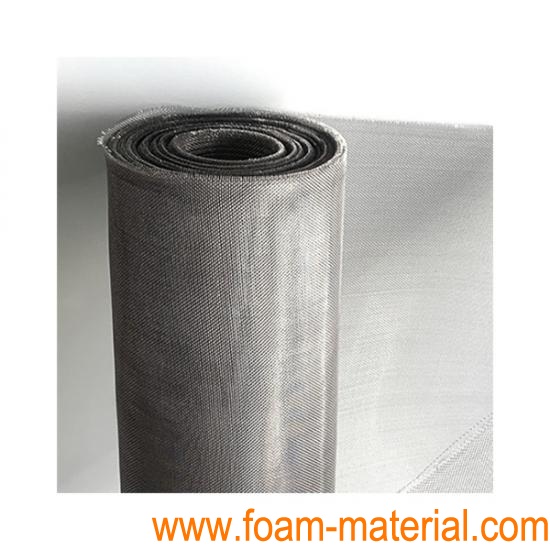
Stainless Steel Metal Mesh
Applications
Stainless steel mesh finds extensive applications across diverse industries:
Filtration and Separation: Used in water treatment, chemical processing, air filtration, and oil separation.
Architectural and Decorative: Applied in facades, partitions, screens, and interior design for both functional and aesthetic purposes.
Industrial: Reinforcement in composite materials, sieving, grading, and mechanical protection.
Food and Pharmaceutical: Used in processing equipment, sieves, and hygienic barriers due to its corrosion resistance and easy cleaning.
Medical and Scientific: Employed in laboratory sieves, protective barriers, and sterile filtration systems.
Advantages
The advantages of stainless steel mesh include:
Longevity: Resistant to corrosion, wear, and temperature variations, providing long-term performance.
Structural Integrity: Maintains mechanical strength and dimensional stability under stress.
Versatility: Available in various wire diameters, mesh sizes, and weave patterns to meet different requirements.
Hygienic Properties: Non-toxic, easy to clean, and suitable for sensitive environments.
Cost-Effectiveness: Low maintenance, high durability, and multi-functional use make it a cost-efficient solution.
Customizability: Can be fabricated into sheets, rolls, panels, or complex shapes for specialized applications.
Conclusion
In conclusion, stainless steel mesh is a highly versatile and durable metal material offering superior strength, corrosion resistance, and adaptability. Its precise manufacturing, adjustable pore size, and customizable weave patterns enable a wide range of industrial, architectural, and scientific applications. Combining mechanical robustness, hygienic properties, and long service life, stainless steel mesh remains an essential material in modern engineering, filtration systems, decorative structures, and specialized technological applications, providing reliability and performance in demanding environments.


 Daisy@foam-material.com