Selecting high-efficiency substrates for redox flow batteries often leaves engineering teams balancing active surface area against internal flow resistance. Planar materials restrict electrolyte penetration and drive up operational pumping losses during continuous cycling. A properly structured carbon foam electrode solves this trade-off by combining continuous cellular ligaments with an open reticulated architecture. This configuration delivers abundant reaction sites, stable fluid permeability, and uniform current distribution across diverse electrochemical environments.
Traditional planar carbons restrict fluid flow to their outer surfaces, forcing cells to operate under steep concentration gradients. In contrast, three-dimensional cellular carbons allow the electrolyte to permeate the entire internal matrix without causing excessive hydraulic drag. This open geometry shortens ion transport distances and prevents local depletion near the reaction zone.
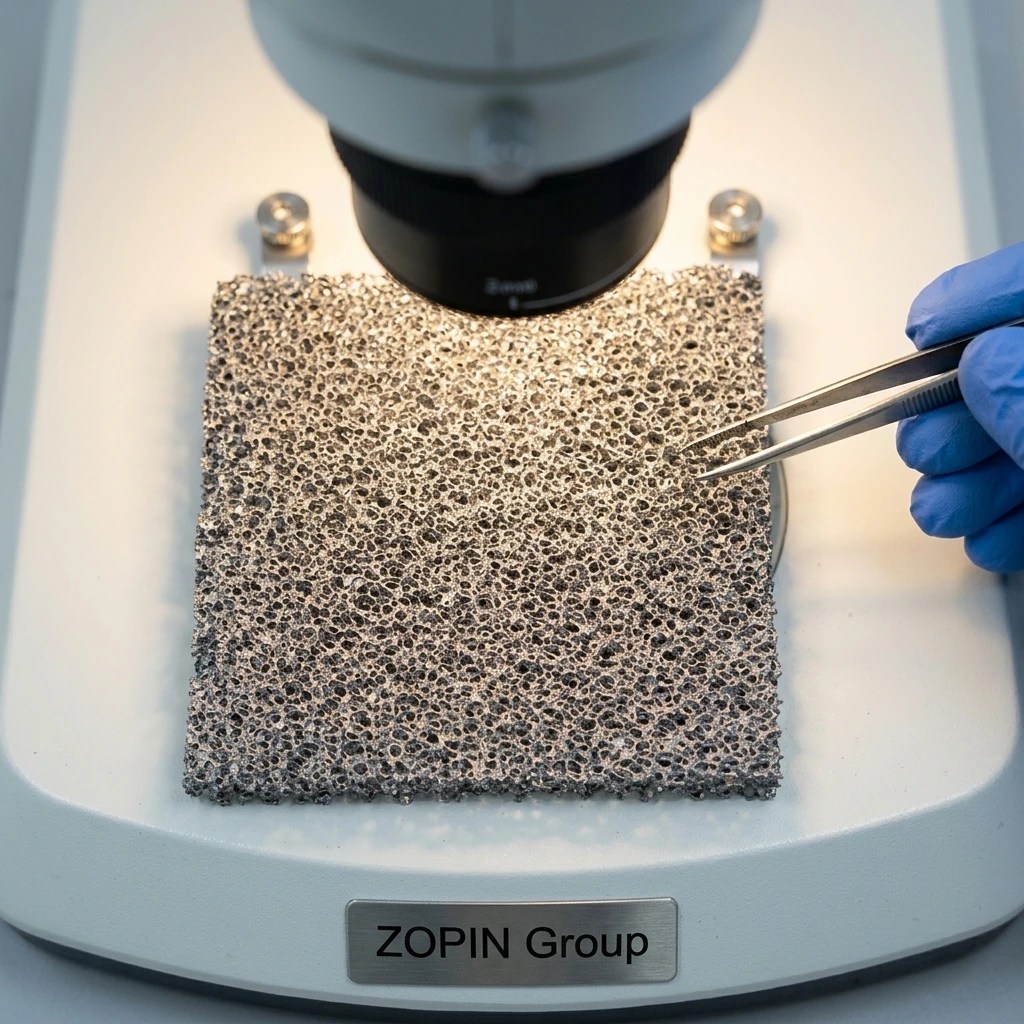
The interconnected porous framework functions as a reliable porous carbon current collector, eliminating the sharp voltage drops that often impair high-current discharge profiles. Continuous conductive pathways maintain low internal resistance under continuous chemical stress. Engineers can evaluate specialized materials through the section to match ligament thickness with targeted cell operating pressures.
Pressure management inside dynamic flow stacks directly dictates overall system efficiency. Dense carbon felts often exhibit severe compression variance, which leads to channeling and dead zones across active stack chambers. Cellular carbon substrates provide rigid structural integrity, maintaining defined flow paths even under heavy cell compression.
Using reticulated carbon as a flow battery carbon anode ensures steady contact across the entire bipolar plate junction. This mechanical rigidity stabilizes electrolyte distribution across tall cell stacks, suppressing localized overpotentials that cause electrolyte degradation. For systems operating alongside complementary metallic current distribution layers, pairing carbon matrices with materials from the portfolio allows targeted optimization of fluidic flow and electrical contact resistance.
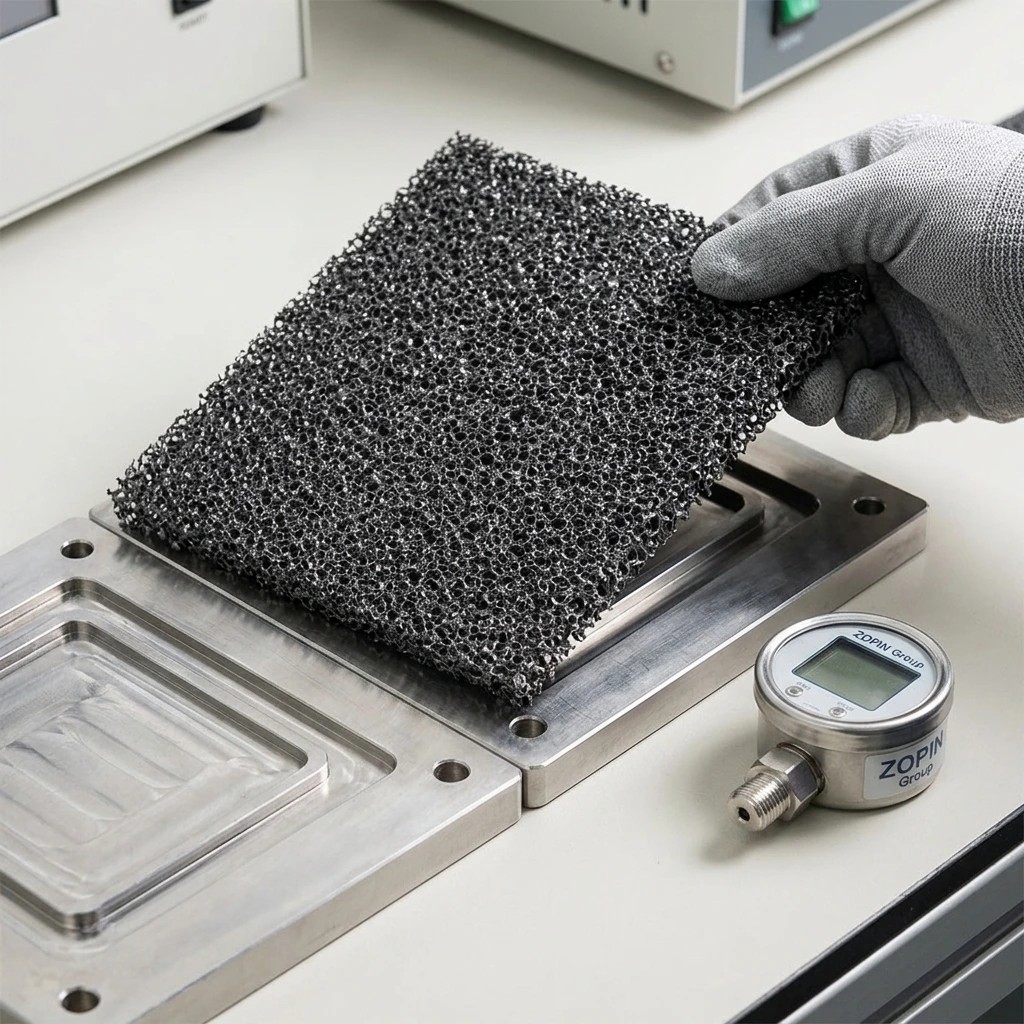
Electrochemical double layer capacitors demand rapid charge transport through high accessible surface areas without resistive thermal buildup. Dense fibrous pads frequently suffer from poor through-plane conductivity and irregular pore distribution, slowing down charge transfer rates during dynamic power surges.
Cellular foam architectures serve as an effective supercapacitor carbon matrix, offering low tortuosity for accelerated ion exchange. Uniform pore apertures allow deep electrolyte soaking, enabling active capacitor materials to cycle at elevated rates without premature drying. In multi-layer power assemblies, these porous structures interface directly with a solid conductive carbon plate, minimizing interfacial resistance while preserving overall mechanical durability.
Integrating rigid porous electrodes into automated stack manufacturing lines requires precise dimensional tolerances. Unlike soft non-woven mats that fray or bunch during automated handling, rigid carbon sheets allow accurate robotic placement and uniform edge compression sealing. This structural consistency drastically reduces the risk of cell leakage or short circuits around stack perimeter gaskets.
Thermal management during high-power cycling represents another critical consideration. The continuous carbon skeleton conducts parasitic heat away from internal reaction zones straight to external cooling surfaces. To explore tailored thicknesses, pore counts, and specific substrate combinations for emerging stack configurations, engineering teams can review advanced options in the catalog to verify exact manufacturing tolerances.
Standard flow frames and compression gaskets readily accommodate rigid porous sheets without requiring custom frame retooling. When utilized as a flow battery carbon anode, uniform thickness controls provide reliable stack sealing pressure without the fiber migration associated with traditional felts.
Evaluation orders can begin from a minimum quantity of one piece, enabling rapid prototyping without inventory commitments. Standard stock specifications are dispatched promptly, while custom pore and dimension requests are processed according to stack requirements.
The unbroken skeletal framework acts as an efficient supercapacitor carbon matrix, lowering equivalent series resistance across high-power charge and discharge cycles. This structure maintains rapid ion pathways through open channels without increasing overall stack compression.

Copyright © Xiamen Zopin New Material Limited. All Rights Reserved.
the professional team to service !

 Daisy@foam-material.com