Xiamen Zopin New Material Limited Established in 2011, it is a new material industry with capabilities of independent research & development, production and sales as one. Our ISO9001:2012 factory covers an area of 6 hectares and a building area of 28,000 square meters, with annual production of high-performance metal foams of 250,000 square meters. Our R&D team is composed of academicians and experts from Tsinghua University, Polytechnic University of Hong Kong, Nanyang Technological University, and other domestic and foreign metal foam professionals. After many years’ endeavor, we now own our proprietary intellectual property rights in manufacturing high purity and high porosity metal foams.
Silver and Multimetal Foam: Advanced Porous Metal Materials for High-Performance Applications
Overview
Silver and multimetal foam materials represent a rapidly evolving class of advanced porous metals characterized by their three-dimensional interconnected structures and multifunctional properties. These materials combine the intrinsic advantages of silver—such as excellent electrical and thermal conductivity—with the synergistic effects of additional metals, including nickel, copper, or platinum. The resulting multimetal foam structures offer enhanced mechanical strength, catalytic performance, and corrosion resistance. Due to their high surface area, tunable porosity, and structural versatility, silver and multimetal foams have become key materials in fields such as energy storage, catalysis, electronics, and environmental engineering.
Properties
Silver and multimetal foams exhibit a unique combination of physical, chemical, and functional properties:
1. High Porosity and Surface Area
The open-cell structure provides a large specific surface area, which significantly enhances interactions at solid–liquid or solid–gas interfaces. This feature is particularly advantageous for catalytic and electrochemical applications.
2. Excellent Electrical Conductivity
Silver, known as one of the most conductive metals, ensures efficient electron transport throughout the foam network. When combined with other conductive metals, the electrical performance can be optimized for specific applications.
3. Thermal Conductivity
The metallic framework enables rapid heat dissipation, making these foams suitable for thermal management systems in high-power devices.
4. Mechanical Strength and Lightweight Nature
Despite their low density, multimetal foams maintain structural integrity and mechanical robustness due to their interconnected lattice architecture.
5. Chemical Stability and Corrosion Resistance
The incorporation of noble or corrosion-resistant metals enhances durability, especially in harsh chemical or electrochemical environments.
6. Tailorable Composition and Structure
By adjusting metal ratios, pore size, and fabrication methods, the properties of multimetal foams can be precisely engineered to meet specific performance requirements.
Fabrication Process
The production of silver and multimetal foam involves several advanced manufacturing techniques, each allowing control over structure and composition:
1. Template-Assisted Methods
Polymeric or ceramic templates (such as polyurethane foam) are coated with metal precursors. After deposition, the template is removed via thermal or chemical treatment, leaving behind a porous metallic replica.
2. Electrodeposition
Electrochemical deposition is widely used to coat conductive templates with silver and other metals. By controlling current density and electrolyte composition, uniform and well-adhered coatings can be achieved.
3. Powder Metallurgy
Metal powders are mixed with space-holding materials, compacted, and sintered. The space holders are then removed to create controlled porosity. This method is suitable for large-scale production.
4. Dealloying Techniques
Selective removal of one or more elements from an alloy can create nanoporous metal structures. For example, leaching less noble metals from a silver-based alloy yields a highly porous silver-rich foam.
5. Additive Manufacturing
Emerging 3D printing technologies enable precise control of foam architecture, allowing the fabrication of complex multimetal structures with designed porosity gradients and geometries.
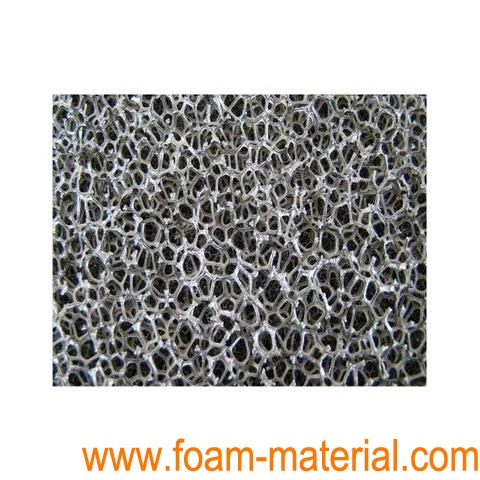
Ag-Ni Alloy Foam
Applications
Silver and multimetal foam materials are widely used in advanced technological fields:
1. Energy Storage and Conversion
These foams serve as current collectors or electrode materials in batteries, supercapacitors, and fuel cells. Their high conductivity and surface area improve charge transfer and energy efficiency.
2. Catalysis
Multimetal foams are highly effective catalysts for chemical reactions, including hydrogen evolution, oxygen reduction, and carbon dioxide reduction. The combination of metals enhances catalytic activity and selectivity.
3. Environmental Engineering
They are used in water purification, air filtration, and pollutant degradation due to their adsorption capacity and catalytic properties.
4. Electronics and Thermal Management
Silver-based foams are applied in heat sinks, electromagnetic shielding, and conductive components for high-performance electronic devices.
5. Biomedical Applications
Due to silver’s antimicrobial properties, these foams are used in medical devices, wound dressings, and implantable materials, where both structural support and infection control are required.
Advantages
Silver and multimetal foam materials offer several key advantages compared to conventional dense metals:
1. Enhanced Functional Efficiency
The high surface-to-volume ratio improves catalytic and electrochemical performance.
2. Material Efficiency
Reduced material usage due to porosity lowers cost while maintaining functionality.
3. Multifunctionality
Combining different metals enables the integration of electrical, thermal, catalytic, and mechanical properties into a single material system.
4. Design Flexibility
Advanced fabrication methods allow customization of pore size, shape, and composition for targeted applications.
5. Improved Durability
Multimetal compositions enhance resistance to wear, oxidation, and corrosion.
Conclusion
Silver and multimetal foam materials represent a significant advancement in the field of porous metal engineering. Their unique combination of high conductivity, structural integrity, and tunable properties makes them ideal for a wide range of high-performance applications. As fabrication technologies continue to evolve, these materials are expected to play an increasingly important role in next-generation energy systems, environmental solutions, and advanced electronics. The ongoing integration of material science, nanotechnology, and manufacturing innovation will further unlock the potential of silver and multimetal foams, driving progress toward more efficient and sustainable technologies.


 Daisy@foam-material.com