Xiamen Zopin New Material Limited Established in 2011, it is a new material industry with capabilities of independent research & development, production and sales as one. Our ISO9001:2012 factory covers an area of 6 hectares and a building area of 28,000 square meters, with annual production of high-performance metal foams of 250,000 square meters. Our R&D team is composed of academicians and experts from Tsinghua University, Polytechnic University of Hong Kong, Nanyang Technological University, and other domestic and foreign metal foam professionals. After many years’ endeavor, we now own our proprietary intellectual property rights in manufacturing high purity and high porosity metal foams.
Wire Mesh Stainless Steel: A Comprehensive Guide to High-Performance Laboratory and Industrial Materials
Overview
Wire mesh stainless steel is a versatile and durable material widely used in laboratories, scientific research, industrial manufacturing, filtration systems, battery production, chemical processing, and high-temperature applications. Manufactured by weaving or welding stainless steel wires into a uniform mesh structure, this material combines excellent mechanical strength with superior corrosion resistance, making it an indispensable component in demanding environments.
In laboratory applications, wire mesh stainless steel is commonly utilized as electrode current collectors, catalyst supports, filtration media, sample holders, heat-resistant carriers, and protective screens. In industrial settings, it serves as an essential material for sieving, screening, separation, reinforcement, and shielding. With various mesh counts, wire diameters, weave patterns, and stainless steel grades available, stainless steel wire mesh can be customized to meet specific operational requirements.
As industries continue to demand higher material performance, especially in advanced battery manufacturing, fuel cells, hydrogen energy systems, and precision laboratory research, wire mesh stainless steel remains a preferred choice due to its reliability, long service life, and outstanding physical properties.
Key Characteristics
High-quality wire mesh stainless steel offers a unique combination of physical, chemical, and mechanical characteristics that distinguish it from alternative metallic and polymer mesh materials.
Excellent Corrosion Resistance
One of its most valuable properties is exceptional resistance to corrosion. Stainless steel grades such as 304, 316, 316L, 310S, and 321 contain chromium and other alloying elements that form a passive oxide layer, protecting the material from oxidation, acids, alkalis, moisture, and many chemical reagents.
Outstanding Mechanical Strength
Despite its lightweight structure, stainless steel wire mesh exhibits high tensile strength and excellent dimensional stability. It maintains structural integrity under continuous mechanical stress, making it suitable for both laboratory equipment and industrial processing systems.
High Temperature Performance
Many grades of wire mesh stainless steel can withstand elevated temperatures exceeding 800°C, depending on the alloy composition. This makes the material ideal for furnace applications, catalyst supports, thermal processing equipment, and sintering operations.
Excellent Electrical and Thermal Conductivity
Compared with polymer mesh materials, stainless steel provides better electrical conductivity and thermal conductivity, making it useful in electrochemical experiments, battery current collectors, conductive supports, and heat transfer systems.
Precise Mesh Uniformity
Modern manufacturing technology enables highly consistent aperture sizes, wire diameters, and mesh geometry. Uniform openings improve filtration accuracy, fluid flow distribution, and experimental repeatability.
Manufacturing Process
The production of wire mesh stainless steel involves several precision manufacturing stages to ensure superior quality and performance.
Raw Material Selection
The process begins with selecting premium stainless steel wire according to the desired application. Common grades include:
SS304
SS304L
SS316
SS316L
SS310S
SS321
Each alloy provides different levels of corrosion resistance, temperature capability, and mechanical strength.
Wire Drawing
Large stainless steel rods are drawn through precision dies to achieve the required wire diameter. Advanced drawing techniques produce smooth surfaces while maintaining excellent tensile strength.
Weaving or Welding
Depending on the intended application, the wires are manufactured into mesh using different techniques:
Plain weave
Twill weave
Dutch weave
Reverse Dutch weave
Welded wire mesh
Computer-controlled weaving machines ensure consistent spacing and dimensional accuracy throughout the mesh.
Heat Treatment
Some products undergo annealing or stress-relief treatment to improve flexibility, reduce internal stress, and enhance corrosion resistance.
Surface Finishing
The finished mesh may receive additional treatments including:
Acid pickling
Electro-polishing
Passivation
Ultrasonic cleaning
These processes remove surface contaminants and improve cleanliness for laboratory or pharmaceutical applications.
Quality Inspection
Every batch undergoes strict inspection for:
Mesh count accuracy
Wire diameter tolerance
Aperture consistency
Tensile strength
Surface quality
Corrosion resistance
Advanced optical inspection equipment ensures compliance with international quality standards.
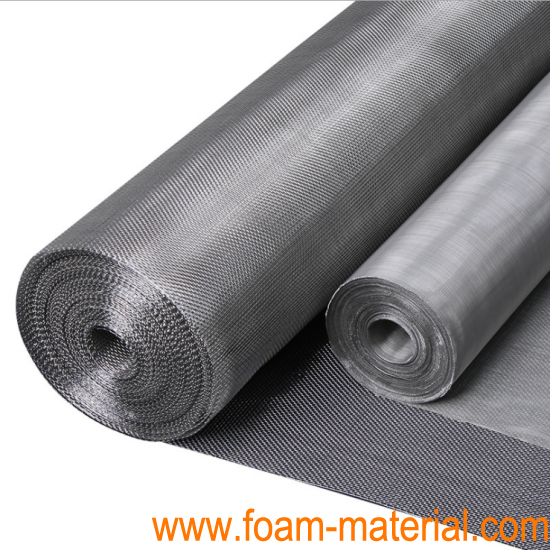
Stainless Steel Wire Woven Net
Applications
Thanks to its versatility, wire mesh stainless steel is used across numerous scientific and industrial sectors.
Laboratory Research
Research laboratories utilize stainless steel mesh for:
Electrode substrates
Sample holders
Catalyst supports
Filtration experiments
Vacuum systems
High-temperature testing
Electrochemical research
Battery Manufacturing
In advanced battery production, stainless steel wire mesh serves as:
Current collectors
Electrode support structures
Separator supports
Solid-state battery components
Fuel cell electrodes
Its conductivity, corrosion resistance, and mechanical stability make it particularly valuable for lithium-ion and solid-state battery research.
Chemical Processing
Chemical plants employ stainless steel mesh in:
Liquid filtration
Gas purification
Catalyst carriers
Distillation equipment
Reactor internals
Its resistance to aggressive chemicals extends equipment life while reducing maintenance costs.
Environmental Protection
Wire mesh is widely used in:
Water treatment
Air filtration
Dust collection
Wastewater purification
Industrial emission control
Food and Pharmaceutical Industries
Food-grade stainless steel mesh is commonly applied in:
Food filtration
Drying systems
Sterilization equipment
Pharmaceutical processing
Cleanroom production lines
Its hygienic surface and ease of cleaning meet strict regulatory requirements.
Advantages
Compared with alternative mesh materials, wire mesh stainless steel offers numerous advantages.
Long Service Life
Its superior corrosion resistance and mechanical durability significantly reduce replacement frequency and maintenance costs.
Chemical Stability
The material remains stable when exposed to a wide range of chemicals, solvents, acids, and alkaline solutions.
High Precision
Consistent mesh openings improve filtration efficiency and enhance the accuracy of laboratory experiments.
Easy Fabrication
Stainless steel wire mesh can be cut, bent, welded, rolled, and formed into customized shapes without compromising structural performance.
Sustainable and Recyclable
Stainless steel is 100% recyclable, making it an environmentally responsible material that supports sustainable manufacturing practices.
Low Maintenance
The smooth surface resists contamination and is easy to clean, reducing operational downtime in both laboratory and industrial environments.
Wide Customization Options
Manufacturers can provide customized:
Mesh count
Wire diameter
Opening size
Sheet dimensions
Roll width
Alloy grade
Surface finish
This flexibility allows engineers and researchers to optimize material performance for specific applications.
Conclusion
Wire mesh stainless steel is a high-performance engineering material that combines exceptional corrosion resistance, mechanical strength, thermal stability, and manufacturing precision. Its versatility has made it an essential component in laboratory research, battery technology, chemical processing, environmental engineering, food production, and countless industrial applications.
With continuous advancements in precision weaving technology, material science, and surface treatment processes, stainless steel wire mesh continues to evolve to meet increasingly demanding technical requirements. Whether used for fine filtration, electrochemical research, catalyst support, or high-temperature processing, wire mesh stainless steel provides reliable performance, outstanding durability, and excellent long-term value. As modern industries pursue higher efficiency, cleaner production, and more sustainable solutions, this versatile material will remain a critical choice for engineers, researchers, and manufacturers worldwide.


 Daisy@foam-material.com