Xiamen Zopin New Material Limited Established in 2011, it is a new material industry with capabilities of independent research & development, production and sales as one. Our ISO9001:2012 factory covers an area of 6 hectares and a building area of 28,000 square meters, with annual production of high-performance metal foams of 250,000 square meters. Our R&D team is composed of academicians and experts from Tsinghua University, Polytechnic University of Hong Kong, Nanyang Technological University, and other domestic and foreign metal foam professionals. After many years’ endeavor, we now own our proprietary intellectual property rights in manufacturing high purity and high porosity metal foams.
Silver Foam: Advanced Experimental Material for Catalysis and Energy Applications
Overview
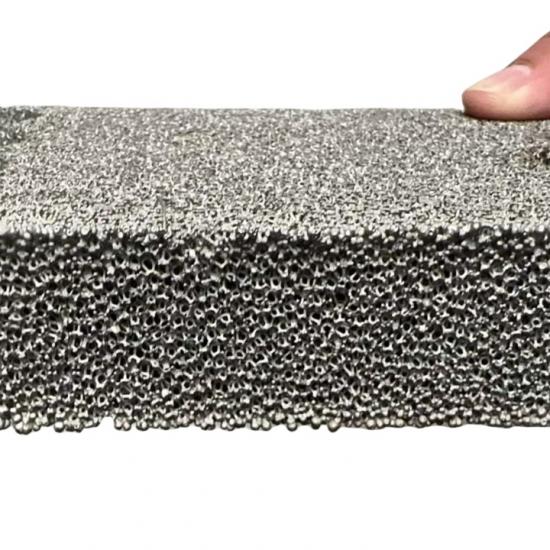
Silver foam is a porous, metallic material composed of interconnected silver networks, offering a high surface area, excellent conductivity, and chemical stability. As an experimental material, silver foam is widely used in research fields such as catalysis, electrochemistry, energy storage, and sensor development. Its unique three-dimensional structure provides a large active surface for reactions, making it ideal for applications where surface-dependent phenomena are critical.
Silver foam stands out among metallic foams for its combination of high electrical and thermal conductivity, chemical inertness, and biocompatibility. Researchers leverage these properties to design electrodes, catalysts, and conductive scaffolds that require uniform current distribution and efficient mass transport. The material is typically fabricated at laboratory scale for experimental studies or small-scale device prototyping.
Characteristics
Silver foam exhibits several properties that make it a valuable experimental material:
1. High Surface Area
The interconnected porous structure results in a significantly larger surface area compared to bulk silver, enhancing reaction rates in catalytic and electrochemical processes.
2. Electrical and Thermal Conductivity
As a metallic foam, silver maintains excellent electrical conductivity, making it suitable for electrodes in fuel cells, batteries, and sensors. Thermal conductivity supports efficient heat dissipation during high-current or exothermic reactions.
3. Chemical Stability
Silver exhibits resistance to oxidation and chemical corrosion under many conditions, allowing prolonged operation in diverse chemical environments.
4. Lightweight Structure
The foam structure reduces material mass while maintaining mechanical stability, which is advantageous for applications where weight is critical.
5. Mechanical Strength
Despite its porosity, silver foam possesses sufficient structural integrity to withstand handling, mechanical stress, and experimental manipulations.
6. Biocompatibility
Silver’s antimicrobial properties and biological compatibility make silver foam a candidate for biomedical devices and antibacterial coatings.
Fabrication Process
Silver foam can be prepared using various experimental techniques, each designed to produce high-porosity, uniform structures:
1. Template Method
A sacrificial template, such as polymer foam or sugar crystals, is coated with silver using techniques like electroplating, chemical deposition, or thermal reduction. After coating, the template is removed by dissolution or calcination, leaving behind a porous silver network.
2. Dealloying Method
Silver-containing alloys are selectively etched to remove less noble metals, creating a porous silver framework with tunable pore size and distribution.
3. Direct Foaming
Silver powders can be combined with foaming agents and then sintered or melted to create interconnected porous structures.
4. Additive Manufacturing
3D printing and laser sintering techniques allow precise control over pore geometry, size, and distribution, enabling custom-designed experimental samples.
Ni Metal Foam
Applications
Silver foam has a wide range of experimental and technological applications:
* Electrochemical Catalysis
High surface area and conductivity make silver foam an ideal support or active material for catalysts in oxygen reduction, CO₂ reduction, and hydrogen evolution reactions.
* Energy Storage and Conversion
Used as electrodes in fuel cells, metal-air batteries, and supercapacitors, silver foam provides efficient electron transport and high reaction surface area.
* Sensors
Silver foam can serve as a conductive scaffold for chemical and biosensors, improving sensitivity due to its large active surface.
* Antimicrobial Applications
Its biocompatibility and inherent antibacterial properties allow use in biomedical scaffolds, water purification, and antibacterial coatings.
* Thermal Management
The combination of high thermal conductivity and porosity enables silver foam to act as heat spreaders or dissipators in microelectronic devices.
Advantages
Silver foam offers multiple benefits for experimental materials research:
1. Enhanced Surface Reactivity: Porosity and high surface area improve reaction kinetics in catalytic and electrochemical applications.
2. Excellent Conductivity: Enables efficient electron and heat transport in energy devices and sensors.
3. Chemical and Thermal Stability: Resistant to corrosion, oxidation, and thermal stress under typical experimental conditions.
4. Lightweight and Structurally Robust: Balances mechanical strength with reduced mass for versatile experimental setups.
5. Customizable Structure: Fabrication methods allow precise control over pore size, geometry, and foam density.
6. Biocompatibility: Suitable for biomedical and antibacterial applications without introducing toxic effects.
Conclusion
Silver foam is a versatile and high-performance experimental material with unique properties that make it invaluable in catalysis, energy conversion, sensors, and biomedical research. Its high surface area, excellent conductivity, chemical stability, and lightweight porous structure allow researchers to design advanced electrodes, catalysts, and functional scaffolds with superior performance.
The ability to tailor pore size, structure, and geometry through various fabrication methods makes silver foam a flexible platform for experimental studies and small-scale prototyping. Its combination of mechanical strength, thermal and electrical conductivity, and biocompatibility ensures that silver foam continues to play a critical role in cutting-edge research and the development of next-generation functional materials.


 Daisy@foam-material.com