Xiamen Zopin New Material Limited Established in 2011, it is a new material industry with capabilities of independent research & development, production and sales as one. Our ISO9001:2012 factory covers an area of 6 hectares and a building area of 28,000 square meters, with annual production of high-performance metal foams of 250,000 square meters. Our R&D team is composed of academicians and experts from Tsinghua University, Polytechnic University of Hong Kong, Nanyang Technological University, and other domestic and foreign metal foam professionals. After many years’ endeavor, we now own our proprietary intellectual property rights in manufacturing high purity and high porosity metal foams.
Ti Mesh: High-Performance Experimental Material for Advanced Applications
Overview
Titanium mesh, commonly referred to as Ti mesh, is a porous, metallic material made from high-purity titanium. It features a network of interlaced titanium wires, forming a three-dimensional structure with exceptional mechanical strength, chemical resistance, and electrical conductivity. Ti mesh is widely used in experimental materials research, electrochemistry, catalysis, energy storage, and biomedical applications due to its unique combination of properties.
As an experimental substrate or structural material, Ti mesh provides a large surface area, excellent electron transport, and mechanical stability, making it suitable for high-performance electrodes, catalysts, and supporting frameworks for thin films or coatings. Its chemical inertness and biocompatibility allow its use in aggressive chemical environments or biomedical experiments without significant degradation.
Characteristics
Ti mesh exhibits a range of properties that make it highly valuable in laboratory and experimental research:
1. High Mechanical Strength
Titanium’s inherent strength, combined with the mesh structure, provides a robust framework capable of withstanding mechanical stress during experimental procedures.
2. Excellent Corrosion Resistance
Titanium forms a stable oxide layer, providing resistance to acids, bases, and oxidative environments, which is critical for long-term stability in chemical and electrochemical experiments.
3. Electrical Conductivity
Ti mesh supports efficient electron transport, making it suitable for electrochemical electrodes, sensors, and energy storage devices.
4. Thermal Stability
Titanium can withstand high temperatures without structural degradation, enabling use in thermal or high-temperature chemical processes.
5. Large Surface Area
The porous mesh structure maximizes the surface area for coating, thin film deposition, or catalytic activity.
6. Biocompatibility
Titanium is widely recognized for its biocompatibility, allowing Ti mesh to be used in biomedical research, implants, and tissue engineering scaffolds.
Fabrication and Preparation
Ti mesh can be produced and prepared using various methods to meet experimental and industrial requirements:
1. Weaving or Knitting
Titanium wires are woven or knitted into a mesh with controlled pore size and thickness, providing a consistent and reproducible structure.
2. Etching or Surface Treatment
Mesh surfaces can be chemically etched or anodized to increase surface roughness, improve adhesion for coatings, or enhance electrochemical activity.
3. Coating and Functionalization
Ti mesh can be functionalized with metals, oxides, or polymers via methods such as electroplating, chemical vapor deposition (CVD), or sputtering, expanding its application potential.
4. Laser or Mechanical Cutting
Mesh can be cut into precise sizes and shapes to fit experimental setups, electrodes, or device prototypes.
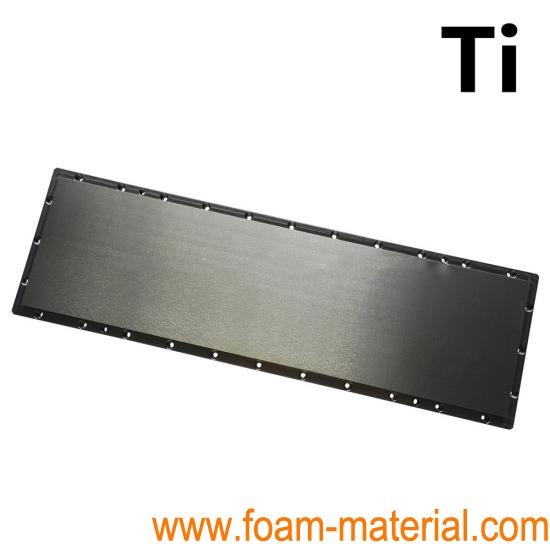
Ti Sputtering Target
Applications
Ti mesh has broad applicability in both laboratory research and industrial experimental studies:
* Electrochemical Devices: Used as electrodes in batteries, fuel cells, and supercapacitors, providing high conductivity and structural stability.
* Catalysis: Serves as a support for catalysts in chemical reactions, photocatalysis, and electrocatalysis due to its high surface area and chemical stability.
* Biomedical Research: Acts as scaffolds for tissue engineering, implants, and antibacterial coatings, leveraging titanium’s biocompatibility.
* Energy Conversion: Supports deposition of thin films or catalysts for hydrogen evolution, oxygen reduction, and CO₂ reduction reactions.
* Thin Film Deposition: Provides a mechanically robust and conductive substrate for deposition of metals, oxides, and hybrid materials.
Advantages
Ti mesh offers several key benefits for experimental applications:
1. Mechanical Robustness: Can withstand stress, handling, and thermal cycling without deformation.
2. Chemical Stability: Resists corrosion, oxidation, and chemical attack, ensuring long-term durability.
3. High Conductivity: Supports efficient electron transport for electrochemical and sensor applications.
4. Enhanced Surface Area: Porous structure facilitates uniform coating, thin film deposition, and catalytic reactions.
5. Thermal Tolerance: Suitable for high-temperature processes without compromising structural integrity.
6. Biocompatibility: Safe for biomedical applications and tissue-contact experiments.
7. Customizability: Pore size, wire thickness, and surface treatment can be tailored for specific experimental requirements.
Conclusion
Ti mesh is a versatile, high-performance experimental material that combines mechanical strength, chemical stability, electrical conductivity, and biocompatibility. Its porous structure and large surface area make it an ideal platform for electrodes, catalysts, thin film deposition, and biomedical scaffolds.
By providing a mechanically robust, chemically inert, and conductive framework, Ti mesh enables researchers to conduct advanced experimental studies in energy, catalysis, materials science, and biomedical engineering. Its adaptability and functionalization potential ensure that Ti mesh remains a critical material for cutting-edge laboratory research and the development of next-generation functional devices.


 Daisy@foam-material.com