Xiamen Zopin New Material Limited Established in 2011, it is a new material industry with capabilities of independent research & development, production and sales as one. Our ISO9001:2012 factory covers an area of 6 hectares and a building area of 28,000 square meters, with annual production of high-performance metal foams of 250,000 square meters. Our R&D team is composed of academicians and experts from Tsinghua University, Polytechnic University of Hong Kong, Nanyang Technological University, and other domestic and foreign metal foam professionals. After many years’ endeavor, we now own our proprietary intellectual property rights in manufacturing high purity and high porosity metal foams.
Titanium Foam: Overview, Features, Manufacturing, Applications, Advantages, and Conclusion
Titanium foam is a high-performance metallic material recognized for its lightweight structure, excellent corrosion resistance, and high strength-to-weight ratio. Composed of a porous titanium network, titanium foam combines the intrinsic properties of titanium with an open-cell or closed-cell structure, providing unique mechanical, thermal, and functional characteristics. This makes it a critical material in aerospace, biomedical, automotive, and energy applications where lightweight, durable, and multifunctional materials are required.
Overview
Titanium foam is typically produced from pure titanium or titanium alloys, with controlled porosity to achieve specific mechanical and thermal properties. The foam’s three-dimensional network allows it to maintain structural integrity while significantly reducing weight. Its combination of corrosion resistance, biocompatibility, and high mechanical strength makes titanium foam ideal for applications such as bone scaffolds, lightweight structural components, heat exchangers, and energy absorbers. The porosity also provides a high surface area, enhancing performance in catalysis and energy storage systems.
Key Features of Titanium Foam
Titanium foam exhibits several distinct features:
High Strength-to-Weight Ratio: Lightweight yet mechanically robust, suitable for structural and load-bearing applications.
Excellent Corrosion Resistance: Titanium’s natural oxide layer protects against chemical attack and environmental degradation.
Biocompatibility: Safe for medical implants and bone tissue engineering applications.
Thermal and Chemical Stability: Maintains integrity under high temperatures and reactive chemical environments.
Porous and Lightweight Structure: Reduces component weight and allows fluid or gas permeability.
Mechanical Energy Absorption: Capable of absorbing shocks and vibrations due to its cellular structure.
Manufacturing Process
Titanium foam can be fabricated through several advanced methods to control porosity, density, and mechanical properties:
Powder Metallurgy with Space Holders: Titanium powder is mixed with a removable space-holder material, compacted, and sintered. The space-holder is then removed, leaving a porous foam.
Foaming of Molten Titanium: Gas injection or chemical foaming agents create bubbles in molten titanium, forming a cellular structure upon solidification.
Template Replication: A polymer or ceramic template is coated with titanium and subsequently removed to create a titanium foam with controlled pore structure.
Additive Manufacturing (3D Printing): Laser or electron beam melting can produce customized foam geometries with precise pore sizes and densities.
These methods allow precise control over foam structure, mechanical properties, and surface characteristics.
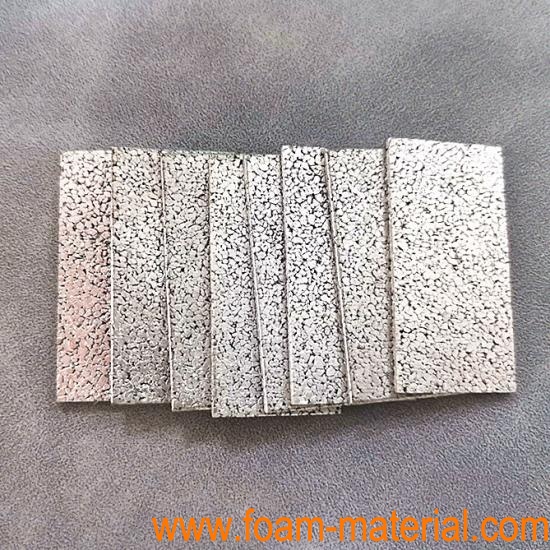
Laboratory Titanium Foam
Applications
Titanium foam finds extensive applications across multiple industries:
Biomedical Implants: Bone scaffolds, dental implants, and orthopedic devices benefit from biocompatibility and porous structure for osseointegration.
Aerospace and Automotive: Lightweight structural components, energy absorbers, and vibration-damping elements improve performance and reduce weight.
Energy Systems: Heat exchangers, fuel cell electrodes, and catalyst supports utilize titanium foam’s high surface area and thermal conductivity.
Filtration and Separation: Porous titanium foam enables gas or liquid filtration in chemical and industrial processes.
Mechanical Damping: Shock absorbers and protective panels exploit the foam’s energy-absorbing characteristics.
Advantages
Titanium foam offers numerous benefits:
Lightweight with High Strength: Reduces component weight while maintaining structural integrity.
Corrosion and Chemical Resistance: Provides long service life in harsh environments.
Customizable Porosity: Pore size, density, and thickness can be tailored for specific applications.
Biocompatibility: Safe for medical and biological uses.
Thermal and Mechanical Stability: Performs reliably under high temperature and mechanical stress.
Versatility: Suitable for aerospace, biomedical, energy, and industrial applications.
Conclusion
In conclusion, titanium foam is a versatile, high-performance material that combines lightweight, mechanical strength, corrosion resistance, and biocompatibility. Its porous three-dimensional structure and high surface area make it suitable for biomedical implants, aerospace and automotive components, energy devices, and industrial filtration systems. Advanced manufacturing techniques allow precise control over foam geometry and properties, enabling titanium foam to meet the growing demand for durable, multifunctional, and lightweight materials in modern engineering and technological applications.


 Daisy@foam-material.com