Developing thin energy storage cells requires current collectors that survive continuous mechanical flexion without losing electrical contact. Standard planar metal substrates often crack under repetitive bending, which increases internal resistance and degrades electrode performance. Implementing a 3d graphene foam structure solves this interface failure by combining continuous electron pathways with high porous volume. This evaluation reviews material parameters, structural metrics, and manufacturing compatibility across thicknesses from 0.1mm to 1.6mm. Engineering teams can quickly benchmark key trade-offs between mechanical compliance and energy density before finalizing pilot production runs.
Selecting the right current collector begins with defining pore density and skeleton connectivity. Unlike conventional metal meshes, features interconnected sp2 carbon networks that conduct electrons throughout the entire electrode volume. The continuous framework avoids particle contact resistance often found in slurries mixed with carbon black.
Thickness ranges between 0.1mm and 1.6mm directly affect volumetric capacitance and electrolyte transport. Ultrathin grades near 0.1mm fit space-constrained pouch cells, while heavier grades up to 1.6mm accommodate thick active material loading for industrial devices. The pore distribution supports fast ion diffusion even under high charge rates.
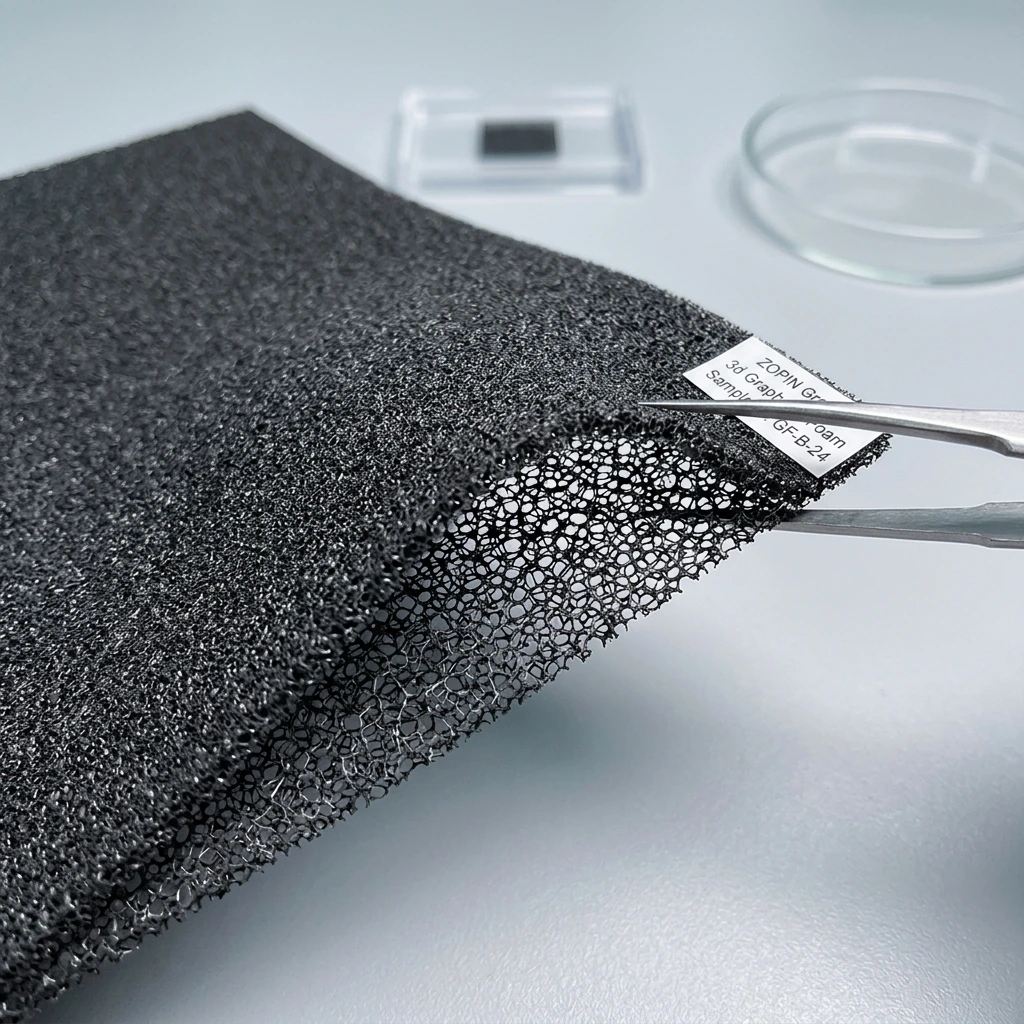
Chemical vapor deposition delivers a matrix without polymeric binders. This process produces high chemical stability across wide electrochemical windows in aqueous and organic electrolytes. Engineers also achieve significant mass reduction compared with traditional metallic substrates.
Handling lightweight porous materials in automated assembly lines requires consistent mechanical stability. Roll-to-roll feeding systems need predictable tensile values to avoid tearing during continuous slurry coating. The open framework allows electrode pastes to penetrate deep into internal cavities instead of resting on top surfaces.
Engineers frequently combine carbon matrices with metallic carriers like during transition testing phases. Comparing these materials clarifies the exact density and thermal benefits of full carbon systems. The black foam remains pliable, allowing tabs to form without damaging the primary conductive paths.
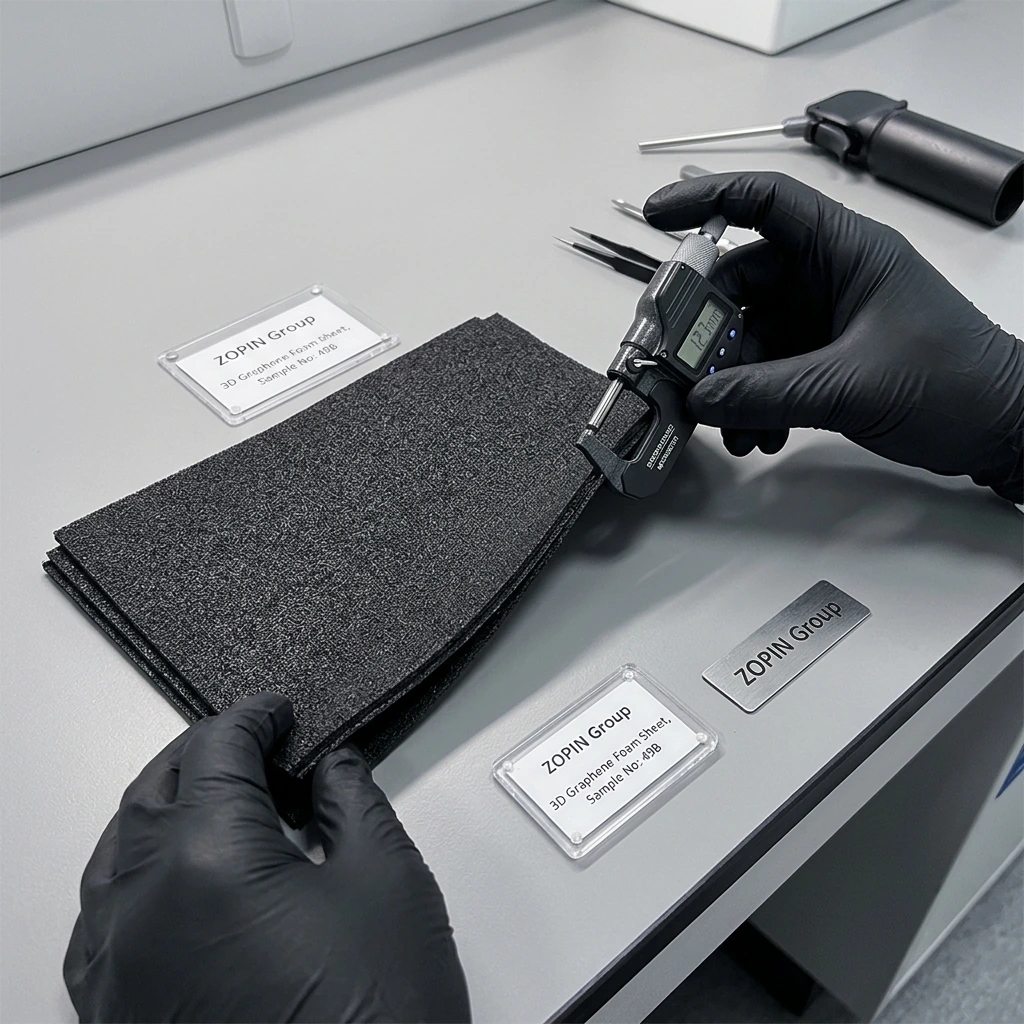
Thermal management represents another core operational advantage during fast charging cycles. Heat generated inside deep electrode layers moves freely through the continuous skeleton, mitigating hot spots that degrade electrolyte salts.
Selecting the correct grade depends on the mechanical and electrical priorities of the end application. The table below outlines standard operational targets for thin cell architectures.
| *Parameter* | *Standard Range* | *Primary Engineering Function* |
|---|---|---|
| Thickness | 0.1 to 1.6 mm | Matches pouch cell dimensions |
| Matrix Structure | 3D interconnected pore network | Promotes electrolyte transport |
| Base Material | CVD grown carbon skeleton | Eliminates binder electrical resistance |
| Target Weight | Low areal density | Increases active material mass fraction |
When designing a flexible supercapacitor scaffold, engineers prioritize open volume fraction to maximize active material loading per square centimeter. Higher pore volumes accommodate pseudo-capacitive oxides and conductive polymers smoothly. Meanwhile, thermal dissipation layers utilize the 3d conductive graphene sheet to conduct heat sideways toward cell packaging boundaries.
Evaluating these parameters early keeps prototypes aligned with volume production processes. Standard die-cutting tools cut precise profiles without crushing edge porosity. Custom cutting services also provide finished shapes ready for stacking.
Standard slurry coating and drying ovens process this substrate with minor web tension adjustments. The mechanical compliance of a flexible supercapacitor scaffold allows smooth feeding through standard roll-press systems, provided winding rollers maintain uniform low tension.
Standard stock profiles ship within 12 to 24 hours to support rapid prototyping schedules. R&D teams evaluate a single 3d conductive graphene sheet with a minimum order quantity of one unit before scaling to full factory batches.

Copyright © Xiamen Zopin New Material Limited. All Rights Reserved.
the professional team to service !

 Daisy@foam-material.com