Xiamen Zopin New Material Limited Established in 2011, it is a new material industry with capabilities of independent research & development, production and sales as one. Our ISO9001:2012 factory covers an area of 6 hectares and a building area of 28,000 square meters, with annual production of high-performance metal foams of 250,000 square meters. Our R&D team is composed of academicians and experts from Tsinghua University, Polytechnic University of Hong Kong, Nanyang Technological University, and other domestic and foreign metal foam professionals. After many years’ endeavor, we now own our proprietary intellectual property rights in manufacturing high purity and high porosity metal foams.
Nickel Foam Electrode: Overview, Features, Manufacturing, Applications, Advantages, and Conclusion
Nickel foam electrodes are advanced electrochemical materials characterized by their high surface area, excellent conductivity, and robust mechanical structure. They consist of porous nickel foam that serves as a three-dimensional current collector or electrode substrate, providing superior performance in energy storage and conversion devices. Nickel foam electrodes are widely utilized in batteries, fuel cells, supercapacitors, and electrocatalysis, offering a combination of structural stability, high efficiency, and versatility.
Overview
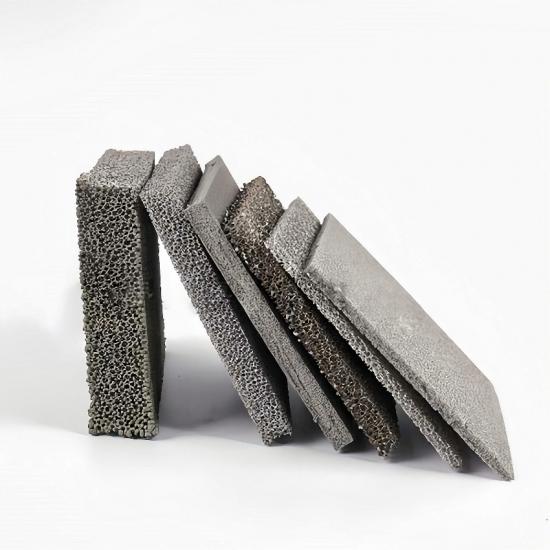
Nickel foam electrodes are fabricated from high-purity nickel, forming a highly porous, interconnected network of nickel struts. The foam’s open-cell structure ensures a large surface area, which enhances electrochemical reactions and improves mass transport of ions and gases. These electrodes provide low internal resistance, high current-carrying capability, and mechanical durability, making them ideal for high-performance energy devices. The unique architecture also allows uniform deposition of active materials, further boosting efficiency and device lifespan.
Key Features of Nickel Foam Electrodes
Nickel foam electrodes exhibit several critical characteristics:
High Surface Area: The porous structure provides extensive active sites for electrochemical reactions.
Excellent Electrical Conductivity: Facilitates efficient electron transfer throughout the electrode.
Mechanical Strength and Flexibility: Maintains structural integrity under compression and mechanical stress.
Corrosion and Chemical Resistance: Durable in alkaline, acidic, or oxidizing environments.
Lightweight and Porous Structure: Promotes efficient ion and gas transport, improving reaction kinetics.
Customizable Geometry: Thickness, porosity, and pore size can be tailored for specific applications.
Manufacturing Process
The production of nickel foam electrodes involves several specialized methods:
Electrochemical Deposition: Nickel is electrodeposited onto a sacrificial template or conductive substrate, creating a uniform foam structure.
Powder Metallurgy with Space Holders: Nickel powder is mixed with removable space-holding materials, compacted, and sintered. The space-holder is then removed to form a porous foam.
Foaming of Molten Nickel: Gas injection or chemical foaming agents create bubbles in molten nickel, forming an open-cell structure upon solidification.
Template Replication: A polymer or ceramic template is coated with nickel, which is later removed to obtain a foam electrode.
These methods allow precise control over pore size, porosity, and mechanical properties to meet application-specific requirements.
Nickel Foam INCO
Applications
Nickel foam electrodes are widely employed in various industries and devices:
Electrochemical Energy Storage: Used as electrodes or current collectors in nickel-metal hydride batteries, lithium-ion batteries, and supercapacitors.
Fuel Cells: Serves as gas diffusion layers or electrode substrates in alkaline and proton-exchange membrane fuel cells.
Electrocatalysis: Acts as a high-surface-area support for catalysts in hydrogen evolution reactions, oxygen evolution reactions, and other electrochemical processes.
Electrolyzers: Provides conductive, porous substrates for water electrolysis and hydrogen production.
Industrial Electroplating: Facilitates uniform deposition of metals and coatings in electrochemical processes.
Advantages
Nickel foam electrodes offer several key advantages:
High Electrochemical Performance: Large surface area enhances reaction rates and energy storage capacity.
Low Internal Resistance: Ensures efficient current flow and minimal energy loss.
Mechanical Durability: Retains shape and performance under compression and repeated cycling.
Corrosion and Chemical Resistance: Provides long-term stability in harsh chemical environments.
Lightweight and Porous: Promotes mass transport and reduces device weight.
Customizable: Pore size, thickness, and porosity can be optimized for specific devices and applications.
Conclusion
In conclusion, nickel foam electrodes are high-performance materials that combine structural robustness, excellent conductivity, and a high surface area to enable efficient electrochemical processes. Their porous three-dimensional architecture supports rapid ion and electron transport, making them ideal for batteries, fuel cells, supercapacitors, and electrocatalysis. With advanced manufacturing techniques allowing precise control over mechanical and structural properties, nickel foam electrodes provide durable, versatile, and efficient solutions for modern energy storage and conversion technologies.


 Daisy@foam-material.com